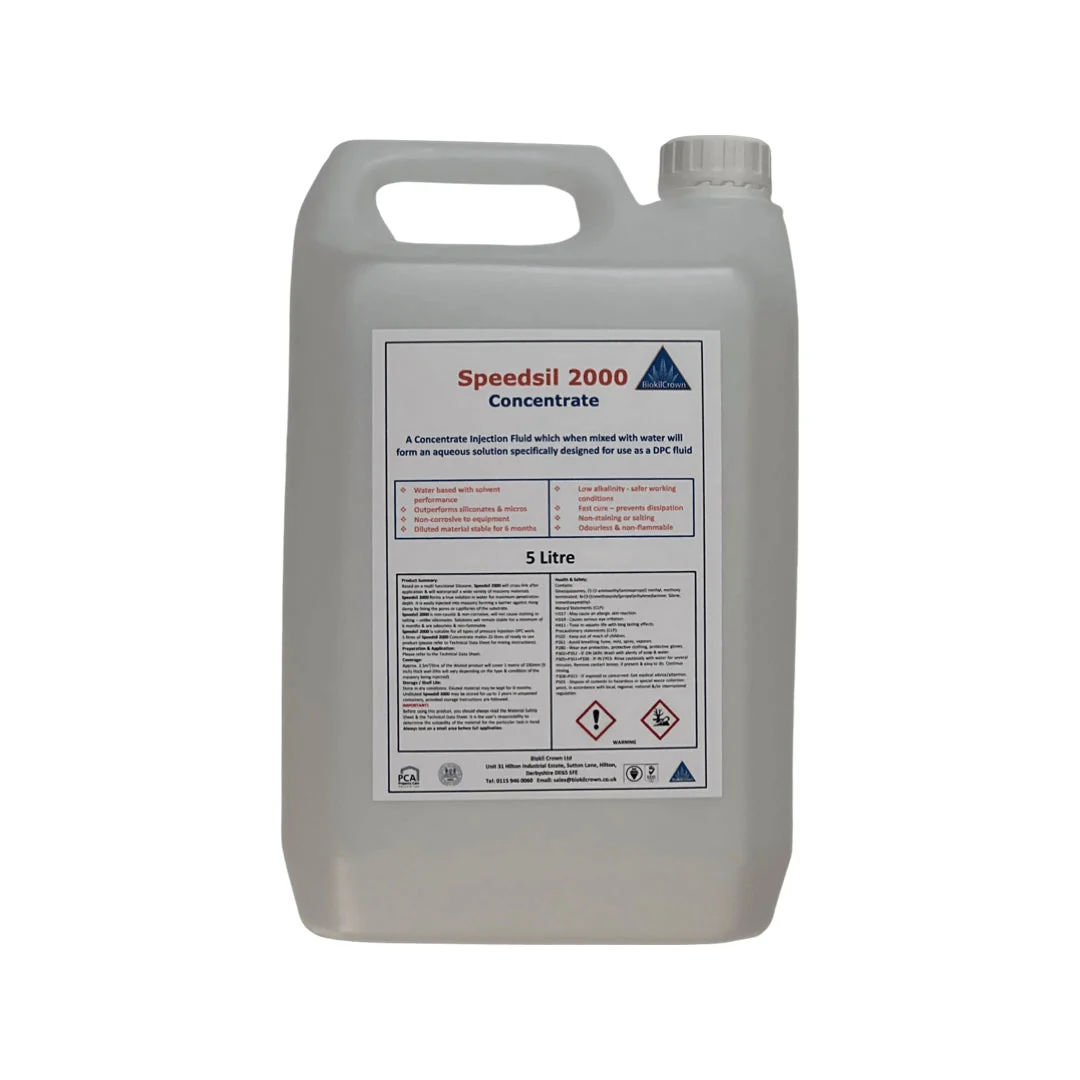
Speedsil 2000 (Concentrate) – Chemical DPC Injection Fluid (5L) - Biokil Crown
Speedsil 2000 (Concentrate) is a high-performance injection fluid used to install a chemical damp proof course (DPC) in masonry. Suitable for all types of pressure injection DPC work, it is a water-based system designed to deliver solvent-based performance while remaining odourless, non-flammable and non-staining.
Key Features
- Water based with solvent performance.
- Out performs siliconates and micros.
- Non-corrosive to equipment.
- Diluted material stable for 6 months.
- Low alkalinity for safer working conditions.
- Fast cure to help prevent dissipation.
- Non-staining or salting.
- Odourless and non-flammable.
Typical Applications
- Injecting a chemical DPC to help control rising damp in masonry walls.
- Pressure injection DPC work where an aqueous (water-based) solution is preferred.
How It Works
When mixed with water, Speedsil 2000 forms an aqueous solution designed for chemical DPC use. Based on a multi-functional siloxane, it cross-links after application to waterproof a wide range of masonry materials. It forms a true solution in water for maximum penetration and works by lining the pores/capillaries of the substrate to create a barrier against rising damp.
Preparation & Application
- External prep: Remove porous/damaged plinths and cut external rendering back above the proposed DPC line. Lower external ground levels where possible, and protect plants/paths/glass from spills (wipe up immediately).
- Internal prep: Remove skirtings (treat and reuse if sound). Remove plaster to at least 1m high or 300mm above the last evidence of damp/salts (whichever is higher). Remove timber fixing grounds and rake out mortar beds 10–15mm ready for replastering.
Drilling Guidance (Brickwork)
- Select the injection line not less than 150mm above external ground level. Internally, aim as close as possible to floor level on solid floors; with suspended timber floors, inject below joists/wall plates where possible.
- Drill two 10–14mm holes at a slight downward angle to approx 2/3 depth of the brick (or through to terminate in a mortar bed where mortar joint injection is required).
- Hole spacing: do not exceed 170mm between holes.
- 115mm walls: drill from one side only.
- 225mm walls: drill from each side, or drill ~75mm, inject, then drill a further ~100mm and inject again.
Injection, Mixing & Finishing
- Walls over 225mm: drill in a stepped manner (preferably from both sides). Cavity walls: treat each leaf as a separate wall. For very damp walls, consider two rows of holes.
- Injection pressure: inject at low pressure 5–50 psi (vary to suit site conditions). Inject until fluid begins to be visible in mortar beds, ensuring sufficient fluid enters the wall.
- Mixing: clean the injection pump thoroughly before use. Always add Speedsil 2000 to the water. Dilute 1 part Speedsil 2000 with 4 parts clean water (by volume). 5L concentrate makes 25L ready-to-use product.
- Finishing: plug external DPC holes with strong cement/sand mortar or plastic plugs. Leave walls as long as possible before replastering.
Coverage
Coverage depends on masonry type and thickness. A useful rule of thumb is 2.5L of fluid per 1 metre of 230mm (9") thick wall.
Aftercare (Replastering & Decoration)
- Replastering must be carried out in accordance with the Biokil Crown Replastering Specification.
- After replastering, decorations should be regarded as temporary for 9–12 months. Use a non-vinyl based emulsion during this period and avoid vinyl paints and woodchip-type wallpapers.
- Maintain good air circulation around damp-proofed, replastered walls.
Cleaning
- Clean spills/runs/residue while wet using detergent and water.
- Dried residue may require methylated spirits.
- Always clean equipment immediately after use with detergent and water.
Storage & Shelf Life
- Store in dry conditions.
- Diluted material may be kept for 6 months.
- Undiluted Speedsil 2000 may be stored for up to 2 years.
Safety
- Read the product label and MSDS before use.
- Concentrate: risk of serious eye damage — wear eye/face protection when diluting (diluted product is not classified).
- If product contacts eyes, rinse immediately with plenty of water and seek medical advice.
- Keep out of reach of children.
Specifications
| Product | Speedsil 2000 (Concentrate) |
|---|---|
| Use | Chemical DPC injection fluid for masonry |
| Pack sizes | 5L (Code 107) / 25L (Code 116) |
| Dilution | 1 part Speedsil 2000 : 4 parts clean water (by volume) |
| Yield (guide) | 5L concentrate makes 25L ready-to-use |
| Appearance | Clear to yellow liquid |
| Solubility | Soluble in water |
| Specific gravity | 1.01 |
| Flash point | > 67°C |
Speedsil 2000 (Concentrate) – Chemical DPC Injection Fluid (5L) - Biokil Crown
Speedsil 2000 (Concentrate) is a high-performance injection fluid used to install a chemical damp proof course (DPC) in masonry. Suitable for all types of pressure injection DPC work, it is a water-based system designed to deliver solvent-based performance while remaining odourless, non-flammable and non-staining.
Key Features
- Water based with solvent performance.
- Out performs siliconates and micros.
- Non-corrosive to equipment.
- Diluted material stable for 6 months.
- Low alkalinity for safer working conditions.
- Fast cure to help prevent dissipation.
- Non-staining or salting.
- Odourless and non-flammable.
Typical Applications
- Injecting a chemical DPC to help control rising damp in masonry walls.
- Pressure injection DPC work where an aqueous (water-based) solution is preferred.
How It Works
When mixed with water, Speedsil 2000 forms an aqueous solution designed for chemical DPC use. Based on a multi-functional siloxane, it cross-links after application to waterproof a wide range of masonry materials. It forms a true solution in water for maximum penetration and works by lining the pores/capillaries of the substrate to create a barrier against rising damp.
Preparation & Application
- External prep: Remove porous/damaged plinths and cut external rendering back above the proposed DPC line. Lower external ground levels where possible, and protect plants/paths/glass from spills (wipe up immediately).
- Internal prep: Remove skirtings (treat and reuse if sound). Remove plaster to at least 1m high or 300mm above the last evidence of damp/salts (whichever is higher). Remove timber fixing grounds and rake out mortar beds 10–15mm ready for replastering.
Drilling Guidance (Brickwork)
- Select the injection line not less than 150mm above external ground level. Internally, aim as close as possible to floor level on solid floors; with suspended timber floors, inject below joists/wall plates where possible.
- Drill two 10–14mm holes at a slight downward angle to approx 2/3 depth of the brick (or through to terminate in a mortar bed where mortar joint injection is required).
- Hole spacing: do not exceed 170mm between holes.
- 115mm walls: drill from one side only.
- 225mm walls: drill from each side, or drill ~75mm, inject, then drill a further ~100mm and inject again.
Injection, Mixing & Finishing
- Walls over 225mm: drill in a stepped manner (preferably from both sides). Cavity walls: treat each leaf as a separate wall. For very damp walls, consider two rows of holes.
- Injection pressure: inject at low pressure 5–50 psi (vary to suit site conditions). Inject until fluid begins to be visible in mortar beds, ensuring sufficient fluid enters the wall.
- Mixing: clean the injection pump thoroughly before use. Always add Speedsil 2000 to the water. Dilute 1 part Speedsil 2000 with 4 parts clean water (by volume). 5L concentrate makes 25L ready-to-use product.
- Finishing: plug external DPC holes with strong cement/sand mortar or plastic plugs. Leave walls as long as possible before replastering.
Coverage
Coverage depends on masonry type and thickness. A useful rule of thumb is 2.5L of fluid per 1 metre of 230mm (9") thick wall.
Aftercare (Replastering & Decoration)
- Replastering must be carried out in accordance with the Biokil Crown Replastering Specification.
- After replastering, decorations should be regarded as temporary for 9–12 months. Use a non-vinyl based emulsion during this period and avoid vinyl paints and woodchip-type wallpapers.
- Maintain good air circulation around damp-proofed, replastered walls.
Cleaning
- Clean spills/runs/residue while wet using detergent and water.
- Dried residue may require methylated spirits.
- Always clean equipment immediately after use with detergent and water.
Storage & Shelf Life
- Store in dry conditions.
- Diluted material may be kept for 6 months.
- Undiluted Speedsil 2000 may be stored for up to 2 years.
Safety
- Read the product label and MSDS before use.
- Concentrate: risk of serious eye damage — wear eye/face protection when diluting (diluted product is not classified).
- If product contacts eyes, rinse immediately with plenty of water and seek medical advice.
- Keep out of reach of children.
Specifications
| Product | Speedsil 2000 (Concentrate) |
|---|---|
| Use | Chemical DPC injection fluid for masonry |
| Pack sizes | 5L (Code 107) / 25L (Code 116) |
| Dilution | 1 part Speedsil 2000 : 4 parts clean water (by volume) |
| Yield (guide) | 5L concentrate makes 25L ready-to-use |
| Appearance | Clear to yellow liquid |
| Solubility | Soluble in water |
| Specific gravity | 1.01 |
| Flash point | > 67°C |
Product Information
Product Information
Shipping & Returns
Shipping & Returns
Description
Speedsil 2000 (Concentrate) is a high-performance injection fluid used to install a chemical damp proof course (DPC) in masonry. Suitable for all types of pressure injection DPC work, it is a water-based system designed to deliver solvent-based performance while remaining odourless, non-flammable and non-staining.
Key Features
- Water based with solvent performance.
- Out performs siliconates and micros.
- Non-corrosive to equipment.
- Diluted material stable for 6 months.
- Low alkalinity for safer working conditions.
- Fast cure to help prevent dissipation.
- Non-staining or salting.
- Odourless and non-flammable.
Typical Applications
- Injecting a chemical DPC to help control rising damp in masonry walls.
- Pressure injection DPC work where an aqueous (water-based) solution is preferred.
How It Works
When mixed with water, Speedsil 2000 forms an aqueous solution designed for chemical DPC use. Based on a multi-functional siloxane, it cross-links after application to waterproof a wide range of masonry materials. It forms a true solution in water for maximum penetration and works by lining the pores/capillaries of the substrate to create a barrier against rising damp.
Preparation & Application
- External prep: Remove porous/damaged plinths and cut external rendering back above the proposed DPC line. Lower external ground levels where possible, and protect plants/paths/glass from spills (wipe up immediately).
- Internal prep: Remove skirtings (treat and reuse if sound). Remove plaster to at least 1m high or 300mm above the last evidence of damp/salts (whichever is higher). Remove timber fixing grounds and rake out mortar beds 10–15mm ready for replastering.
Drilling Guidance (Brickwork)
- Select the injection line not less than 150mm above external ground level. Internally, aim as close as possible to floor level on solid floors; with suspended timber floors, inject below joists/wall plates where possible.
- Drill two 10–14mm holes at a slight downward angle to approx 2/3 depth of the brick (or through to terminate in a mortar bed where mortar joint injection is required).
- Hole spacing: do not exceed 170mm between holes.
- 115mm walls: drill from one side only.
- 225mm walls: drill from each side, or drill ~75mm, inject, then drill a further ~100mm and inject again.
Injection, Mixing & Finishing
- Walls over 225mm: drill in a stepped manner (preferably from both sides). Cavity walls: treat each leaf as a separate wall. For very damp walls, consider two rows of holes.
- Injection pressure: inject at low pressure 5–50 psi (vary to suit site conditions). Inject until fluid begins to be visible in mortar beds, ensuring sufficient fluid enters the wall.
- Mixing: clean the injection pump thoroughly before use. Always add Speedsil 2000 to the water. Dilute 1 part Speedsil 2000 with 4 parts clean water (by volume). 5L concentrate makes 25L ready-to-use product.
- Finishing: plug external DPC holes with strong cement/sand mortar or plastic plugs. Leave walls as long as possible before replastering.
Coverage
Coverage depends on masonry type and thickness. A useful rule of thumb is 2.5L of fluid per 1 metre of 230mm (9") thick wall.
Aftercare (Replastering & Decoration)
- Replastering must be carried out in accordance with the Biokil Crown Replastering Specification.
- After replastering, decorations should be regarded as temporary for 9–12 months. Use a non-vinyl based emulsion during this period and avoid vinyl paints and woodchip-type wallpapers.
- Maintain good air circulation around damp-proofed, replastered walls.
Cleaning
- Clean spills/runs/residue while wet using detergent and water.
- Dried residue may require methylated spirits.
- Always clean equipment immediately after use with detergent and water.
Storage & Shelf Life
- Store in dry conditions.
- Diluted material may be kept for 6 months.
- Undiluted Speedsil 2000 may be stored for up to 2 years.
Safety
- Read the product label and MSDS before use.
- Concentrate: risk of serious eye damage — wear eye/face protection when diluting (diluted product is not classified).
- If product contacts eyes, rinse immediately with plenty of water and seek medical advice.
- Keep out of reach of children.
Specifications
| Product | Speedsil 2000 (Concentrate) |
|---|---|
| Use | Chemical DPC injection fluid for masonry |
| Pack sizes | 5L (Code 107) / 25L (Code 116) |
| Dilution | 1 part Speedsil 2000 : 4 parts clean water (by volume) |
| Yield (guide) | 5L concentrate makes 25L ready-to-use |
| Appearance | Clear to yellow liquid |
| Solubility | Soluble in water |
| Specific gravity | 1.01 |
| Flash point | > 67°C |